Foundation Models Adaptation for Multi-View Multi-Modal Cardiac MRI Segmentation and Direct Ejection Fraction Estimation
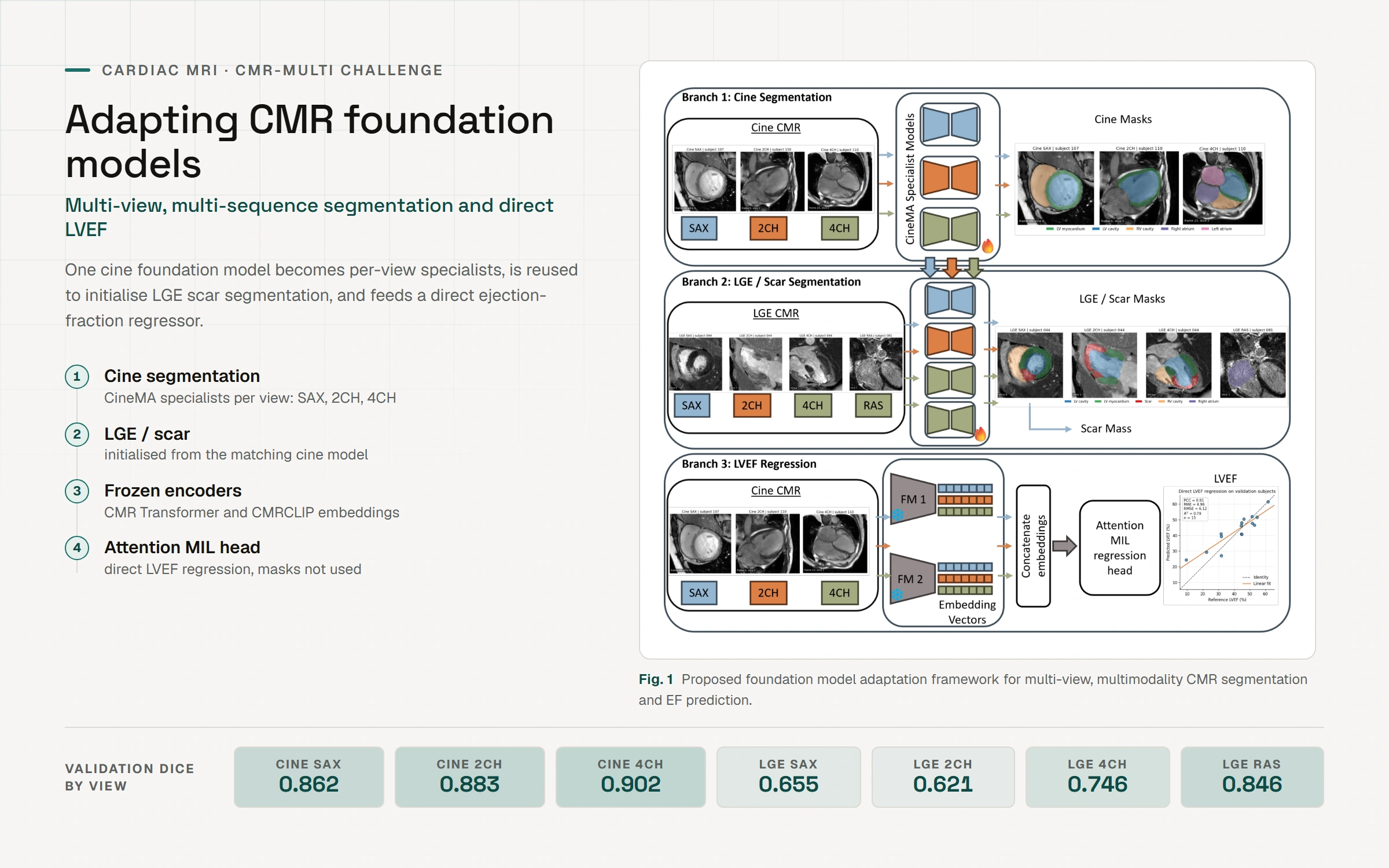
Foundation models show strong transferability in cardiac MRI (CMR), but their effectiveness for heterogeneous multi-view and multi-sequence CMR analysis remains unclear. We explore fine-tuning and combining different CMR foundation models for the Universal Multi-Sequence, Multi-Center and Multi-View CMR Segmentation (CMR-Multi) Challenge. CineMA was fine-tuned for cine and late gadolinium enhancement (LGE) segmentation across short-axis and long-axis views; for direct left-ventricular ejection fraction (LVEF) estimation, two frozen CMR foundation models extracted embedding vectors combined via attention-based multiple-instance learning. On the challenge validation set, cine segmentation reached Dice scores of 0.862 to 0.902 across views, LGE segmentation reached 0.621 to 0.846, and direct LVEF regression achieved an MAE of 4.96 percentage points and a Pearson correlation of 0.91. These results show foundation models can be effectively adapted and combined for multi-view CMR analysis, while accurate LGE scar segmentation remains a challenging task.
Abstract
Foundation models have shown strong transferability in cardiac MRI (CMR), but their effectiveness for heterogeneous multi-view and multi-sequence CMR analysis remains unclear. In this work, we explore the effectiveness of fine-tuning and combining different CMR foundation models for the Universal Multi-Sequence, Multi-Center and Multi-View CMR Segmentation (CMR-Multi) Challenge. CineMA was fine-tuned for cine and late gadolinium enhancement (LGE) segmentation across short-axis and long-axis views. For direct left-ventricular ejection fraction (LVEF) estimation, we used two recent frozen CMR foundation models to extract embedding vectors that were then combined using attention-based multiple-instance learning for LVEF regression.
In the challenge validation set, cine segmentation achieved Dice scores of 0.862, 0.883, and 0.902 for short-axis, two-chamber and four-chamber cine MRI, respectively. LGE segmentation achieved Dice scores between 0.621 and 0.846 across views. The direct LVEF regression model achieved an MAE of 4.96 percentage points and a Pearson correlation of 0.91.
These results indicate that foundation models can be effectively adapted and combined for multi-view CMR analysis, while accurate LGE scar segmentation remains a challenging task.